Archive | February, 2017

Shorty Royalty: SmokeLong Quarterly

28 Feb

On Market Monday* I’m considering my next submission to a giant of very short fiction.

smokelongqThe number of magazines where I’ve submitted more than twice is pretty low, and SmokeLong Quarterly ranks high on that shortlist. I keep knocking on the door because their home has so much love for very short fiction—they publish exclusively flash fiction no longer than 1000 words, and support the form in other powerful ways—and the range of voices they publish is so impressive.

Do I like what they publish? I talked about how much I enjoy a diverse selection of voices when I spotlighted River Styx last Monday. SQ is another rare magazine who finds gold in a variety of approaches and aesthetics. “Straight Lines” by Ryan Werner is a great fabulist flash, and I would label the equally great “Gravity, Reduced” by Kara Oakleaf as speculative fiction. I love this beautifully poetic flash from their Issue Fifty-Four, “The Body’s Amen,” by Brigitte N. McCray. Read that entire issue—you will find realist fiction, more fabulism, a fairy tale, a meta-fiction. Enjoy.

Do they do justice to the published work? Yes, they do a very nice job of setting off each story, but what truly thrills me is their devotion to flash fiction, apparent everywhere you go on that site. You’ll find a high-quality and well-maintained blog with reviews of flash collections, essays about flash fiction, and flash fictions written by children (yep, that’s what I said, see their blog posts marked “Fridge Flash”). They’ve recently launched a “Global Flash Series,” publishing flashes written in other languages alongside English translations. They even offer an annual fellowship (I’ll be applying this year, want to join me?) Like I said: Shorty Royalty, these people.

Do they nominate their authors for awards?** Their History page lists all the usual awards.

Do their guidelines speak to me? Again, they publish a wide range of voices, so this isn’t a magazine that’s going to get you excited about finding a perfect match to your work because of the way they’ve hammered out their wants. But the answer is HELL YES the guidelines speak to me, in that I have rarely come across such sincerity and warmth on a guidelines page. Their dedication to flash fiction shows here as a commitment to the authors they’re eager to publish: Their version of the “We’re writers, too” statement is relatable and friendly, and despite their wide-ranging aesthetic, they take a shot at clarifying for submitters what kinds of stories have a better chance of being selected. Best of all, they ask that you remove identifying information from your ms, so they’re apparently using a review process that is more or less blind. I respect and very much appreciate that approach, and continue to wonder why it’s not more widespread.

If you love very short fiction, you will love this site, for one reason or another. Send SmokeLong Quarterly stories, meditations on flash fiction, and your kid’s latest refrigerator masterpiece. They’re game for it all.

As always, if I’ve inspired you to submit here and your story is accepted for publication, please let me know so I can congratulate you!

.


*Yes, I know, it’s Tuesday. I got a little mixed up over here in DailyShortyLand. Don’t be such a stickler!

** It’s clear to me that if a magazine doesn’t have the presence (and the editors the presence of mind) to nominate their authors, then neither of us should be considering them at all, ever, for our submissions. In other words, nominations isn’t just a plus, it’s a necessity. So I’m dropping this criterion from my Market Monday posts. If you see a magazine recommended for your submissions at Daily Shorty, you can be sure that magazine nominates its authors for awards.
.
.

River Styx: Microfiction Contest

20 Feb

It’s Market Monday, my reminder to spark your ambition. And mine.

If you’ve got all the confidence and energy you need, and you just want an introduction to a new market for your very short fiction, skip to the Market Monday details below. If you’re in the thick of the winter doldrums, if like me you’re so sick at the state of our country you’re finding it hard to show up to the writing (and submitting) desk, if you’re doubting yourself and your work for any reason… read on.

2017 is going to be a year of self-talk, that’s becoming very clear. And that’s what a blog is for, first and foremost, whatever we bloggers like to think: I’m helming this Daily Shorty ship, and these posts are my captain’s log.

Today the captain is heartsick. Just as I was on December 5, when I talked about election dejection, then four weeks later, when I had to remind myself why I write, and then four weeks after that, when I used the words “election dejection” again. The captain’s heart veered from its pattern today because it has been only three weeks since the last time it cracked. This, the captain hopes, is a fluke.

In four weeks, in three weeks, every day, whatever. The solution is work and connection. For writers, work and connection amount to the same thing—writing. But on the other end of the connection is a reader. And no one can read your work if it’s not published.

So you must write. And you must publish. Both of which require ambition. And it’s tough to nurse ambition when you’re heartsick. Today I need a little help. So to follow through on this Market Monday blog post, I ignite my ambition by turning to my mother:

Over and over, as a girl-then-teen-then-very young adult, far too many times to guess at a count, over and over like the caption to the picture of my face, like a motto taped to the fridge, like theme music for the sitcom starring the nice-enough-but-comically-bumbling me, my mother said, “Ambition is unattractive in a woman.”

Oh, you were expecting encouragement? She’s not that kind of mom. But you’re in luck, because I am that kind of blogger, and I hereby offer this toast, which I have silently made to myself for many years now, every time I need to light a fire under my own ass: Here’s to being ugly.

Here’s to wanting to be seen and heard. Here’s to wanting your words to live in the world, your stories to linger in the mind of someone you will never meet. Here’s to answering the call, to donning your superhero costume, to screwing up your who-cares-if-it’s-pretty face and howling at the moon (at 10:00 in the morning, if that’s when you find time to work, the moon is out there like always, I promise). Here’s to doing your job.
.


Spotlighting River Styx’s Microfiction Contest

I could have picked a better season to talk about River Styx’s microfiction contest, given its December 31 deadline, but I vowed to highlight on Market Mondays my preferred magazines who have published my own micros and flashes before moving on to my hopefuls. I’ve got a flash coming out in March, but until then, River Styx is the last journal that fits the bill. Well, you can’t say you don’t have time to prepare a submission.

Do I like what River Styx publishes?  Yes, and what’s more, I think most would agree, given the wide range of voices RS publishes, something I’ve found rare in my review of litmags. RS is living on a new site and they haven’t yet populated all their archives pages, but I quickly found some live links to shorties I love, including Allison Alsup’s “Pioneers,” Ethel Rohan’s “That Mama,” and Amina Gautier’s “Minnow.” All stories about material I would never address and in a voice I would never come close to adopting, yet I was published here, too. I really appreciate that kind of diversity.

Aesthetics? Again, River Styx is unusual in that they produce lovely print journals but also maintain a very polished and substantial online presence.

Do they nominate authors for awards? Yep. All the usual ones accounted for on their About page.

Guidelines? As I’ve noted already, there’s no particular aesthetic the magazine appears to be aiming for. Instead it’s apparently all comers welcome, and your modest entry fee (only $10 if you don’t want a subscription) gets you three bites at the apple. They limit their contest entries to 500 words.


.
The personal is the universal, we writers like to say. It reminds us why our stories matter. If my protagonist finds solace by the end of the story I give her, a reader, somewhere, may find that same solace. Or inspiration or justified anger or cathartic bleakness—whatever was my goal, my ambition, for the story. The personal is the universal, so I keep a captain’s log in the hope I tell you something about your writing life, or—talk about ambition, wish of wishes—I give you a small tool to help you on your path.

Today I am heartsick. But just that little bit more ambitious from having written this post. I hope it’s catching.
.
.

AWP Note: Women Who Submit

13 Feb

The AWP Conference and a Maine blizzard scotches a proper Market Monday. Instead I’ll point you to a resource for building submissions energy and support.

womenwhosubmitlogoMy every-minute-packed trip to the Association of Writers & Writing Programs conference in Washington, D.C. was extended by a day on the front end so I could get out before a snow storm, and extended yesterday on the back end by nail-biting hours of travel home through a pre-blizzard snow storm. Today, blizzard. And unpacking, scrounging didn’t-prepare-for-the-blizzard meals from leftover crackers and chunks of cheese, a leak in the dining room. Tomorrow, digging out. In short: I am tired, lazy, and feeling irresponsible. So tonight I eschew the labor of putting together a proper Market Monday post, and instead introduce you to far more responsible folk.

Women Who Submit put on a lively and inspiring panel at AWP, where they introduced me to the idea of a “submissions party.” A group meets at a member’s house or a suitable public space, everyone brings food and drink to share, and Let the submissions begin! The more experienced members of the group show others the ropes, assisting with the language of cover letters, introducing markets, answering FAQs. They even line up speakers like journal editors and other members of the writing and publishing community. Sounds wonderful, and just the thing I needed when I first got started submitting my short stories.

The best part? They call it a submissions party because the bulk of the event is spent actually doing submissions. And every time someone hits “send” on an electronic submission or slaps a stamp on snail-mail, everyone applauds.

The group was founded in Los Angeles, but there are other groups around the country, and the panelists said they’re happy to hear from anyone interested in finding or starting a group—see their “About” page for e-mail addresses. Or, if you’re like me and you already have a submissions schedule that works for you, just surf their website and absorb the badass energy of these women. And think about connecting with one or more writing friends to develop your own support-and-celebrate routine to energize the work.

I’ll sign off with an anecdote shared by one of the ladies at the panel, founding member Dr. Ashaki M. Jackson. She said a writing friend who happens to be a submitting machine once told her she’d submitted to the same journal 15 times before they accepted a story. When asked about this tenacity, she replied with the astonishing, “Well, I knew they’d accept something eventually.” Astonishing because apparently she said it like “Duh” and because confidence like that among my writer friends is… well, not just rare, I don’t have any writer friends with that confidence. But I should, and I should have that confidence myself. So should you.

I’ve decided to stop being astonished by someone else’s faith in her own work, and use that energy to double my submissions efforts. As soon as it stops snowing. Join me?

.

Mid-American Review’s Fineline Competition

6 Feb

On Market Monday I get to talk about my very first literary magazine crush.

When I first got serious about my writing—or to be more accurate, in the first phase of the very long process of getting serious about my writing—I’d often meet with my friend Kelly at a cafe-bakery in Durham, North Carolina, both of us toting a fat, Post-It-note-bedecked Writer’s Market and a handful of the latest literary magazines we’d sampled, to help each other figure out submissions. We’d talk favorite stories and essays, then move around some Post-Its, then eat salads scattered with candied pistachio nuts. Most distinctly I remember the slabs of fancy cake I’d bring home to share with the husband, and Mid-American Review.

I hugged an issue of Mid-American Review to my chest and declared it the first literary magazine I had read with rapture from cover-to-cover in one sitting. And as it happens, it’s the only literary magazine I have ever read that way. “If I could get published here,” I said then, tapping the cover…. Well, there was no reason to finish the sentence because this was the stuff of fantasy.

MARcover35_1.inddYou know where this is going, so I’ll spare you the details of how many years it took for me to feel confident enough to submit to MAR, then how many times I got a “this was so very close” rejection that made me soar then crash in the space of about 40 seconds… and just break for the finish line: In the fall of 2014, MAR published my micro “Three Things” as part of a special issue celebrating very short prose. I drafted it during my Daily Shorty year on March 18, and barely changed a word before I submitted it to MAR’s Fineline Competition. So I can’t say sweet writing-world-luck has never given me a kiss.
You can’t ask for a more respected magazine to be associated with, and you certainly can’t ask for kinder staff, who send friendly e-mails keeping you up on the publication process, and maintain a blog where they will do whatever they can to promote the authors in their pages. I listed the Fineline Competition on my micro and flash contest page, so a quick peek tells me the deadline is June 1. You’ve got plenty of time to polish three micros of 500 or fewer words. Good luck!

And now to check off the Market Monday boxes:

Do I like what MAR publishes? I’ve answered that, but here I’ll focus specifically on the Fineline micros they’ve published over the years. Unfortunately, MAR publishes very little work on their site, but they do have the 2013 Editors’ Choice micro, Anika L. Eide’s wonderful “Some Parents,”in their sample contents. And after spending far too much time playing Google, I’ve tracked down two other lovely Fineline pieces available online: Jennifer Cheng’s 2013 winning piece from her Letters to Mao; and Andrea Witzke Slot’s “Panoply,” which was published in the same issue as my “Three Things.” You will not find more impressive company for your own work.

Aesthetics? Up to now I’ve looked at markets that publish their work online, but MAR is a print journal. Like almost all print journals, they do a very nice job of presenting the published work. I love their blog, where they post bits and pieces to promote the writers they’ve published. Here’s an interview they did with me, for example. And do yourself a big favor and search their blog for “Pets with MAR.”

The last two are easy: Yes, they nominate their authors for awards; and the guidelines of a contest that lets me submit 3 pieces of micro fiction at once make me very happy indeed.

You just can’t do better than Mid-American Review. When I read any other literary magazine cover-to-cover in one sitting, I’ll be sure to let you know that you should submit there, too. In the meantime, if you’re a lucky Fineline winner or editors’ choice, let me know so I can congratulate you. Happy writing!

.

An Embarrassment of Riches

3 Feb

My 3rd Fiction Friday and already I’m changing the rules. If you love model micros & fab flashes as much as I do, this post pays for my sins.

I love Daily Shorty. It’s my digital home and my digital voice, and the best way to share what I know with other writers and fans of very short fiction. But I need to reserve writing energy and time for my fiction. When I do that, I can count on delivering only one or two substantive posts per week. If I do both a Market Monday and a Fiction Friday every week, I’ve hit my max, leaving me no time, ever, to talk about anything else. So Fiction Friday will have to be a monthly, rather than weekly, feature.

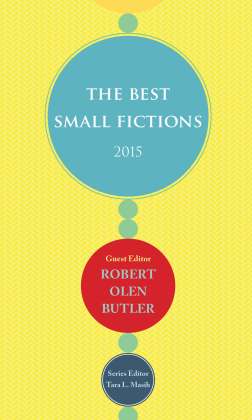
best-small-fictions-2015-coverToday I’m making up for an undelivered Fiction Friday post by bringing your attention to two wonderful anthologies, The Best Small Fictions, 2015 and 2016 (well, and I see 2017 is coming soon). I was ecstatic when I discovered the 2015 collection, and it didn’t disappoint. I got 2016 for Christmas and haven’t yet read it—when I do, I’ll do a post about it. Tonight I get to talk about the 2015 inaugural edition of this series.

Robert Olen Butler is the guest editor of The Best Small Fictions 2015. His Google-able accolades are many and very shiny, but I’m a fan because his story “Jealous Husband Returns in Form of Parrot” is one of my all-time favorites, and Severance, a collection of the final internal monologues of victims of decapitation (victims both imagined, such as Medusa, and real, such as Anne Boleyn) is a wonderful collection of micro fiction. Each micro is limited to 240 words, a number derived from the claims that (1) a severed head retains consciousness for 90 seconds, and (2) human beings think 160 words per minute when in a hyper-emotional state. Gruesome, yes, but I’ve yet to come across a more thrilling conceit.

So the man knows his shit. In particular his short shit. He proves it immediately in his lovely introduction that defines a small fiction as “a lone wolf of a lie,” and then he proves it over and over in the subsequent pages. Anyone skeptical of what very short fiction can achieve needs to read this book. But don’t let me persuade you—the stories below will do the job for me. These are a few of my favorites from the book (the first is my very favorite) that also happen to be available online:

“A Notice from the Office of Reclamation,” by J. Duncan Wiley

“Happiest White Black Man Alive,” by Dan Gilmore

How To Disassemble Your Father’s Ghost (Winter), Jonathan Humphrey

Amazing what one little lone wolf of a lie can do, yes?

.